For me, the study of the End Times has always been a topic of fascination and focus. Way back in 1999, when I finally began to submit to the Lordship of Christ, I began to study the Bible for myself. One thing, in particular, that never seemed to make sense to me was the Pre-Trib Rapture of the church, yet it is still the most popular view amongst American Evangelicals. As I began to study and seek to understand why so many held the Pre-Trib view (surely, reading scripture would clear up my concerns), but as I read, the Pre-Trib view made even less sense. What I found instead was a jarring inconsistency between the Bible and Pre-Trib doctrine.
So I expanded my study to all of the different eschatological views — Post-Trib, Mid-Trib, Preterism, Amillennialism, etc., and it was then that I discovered Robert Van Kampen’s book, The Sign, outlining the Pre-Wrath rapture view. This proved to have the most satisfying reconciliation of the texts out of everything I was studying, and it has been the view that I’ve held for the last 2½ decades.
In the summer of 2025, I began what was supposed to be a quick analysis, but ended up being an extensive research and writing project covering the timing of the crucifixion (posted here: The Crucifixion Chronology). This project afforded me a newfound appreciation for the precision and exactness of the Bible’s language, prophetic claims, and timing as well as a much deeper understanding of the Hebrew calendar and festivals.
With this new appreciation and knowledge, I thought I might find a better understanding of some of the more challenging pieces of the end times narrative — the trumpets and bowls, the two witnesses, the woman’s flight… Instead, once again, what was supposed to be a quick analysis turned into hundreds of hours of detailed analysis. What has emerged is a new ecclesiology (which I call Mutualism) and an eschatological framework that closely resembles the Pre-Wrath view but with some significant differences (which I call the Olivet Rapture view).
Contents
These are all written as standalone articles (more or less), but they do build upon each other. Given the interconnectedness of all of the myriad of moving pieces, it’s hard to find a good starting place — to find an on-ramp to drink from the firehose. If you’re unsure where to start, I recommend just reading them in the order presented here.
NOTE:
As of right now, I am still working on more articles to flesh out the views I now hold, so if you find this content compelling, check back from time to time to see new content I will be posting.
-
- What happens if you treat the time spans that the Bible gives as literal without special pleading to “prophetic years”? This is a detailed analysis of how all of the spans fit together on the Hebrew calendar with striking precision.
- Timeline Visualization
-
- What is the mark of the beast found in Revelation 13 really? Perhaps we’ve been looking at the whole thing the wrong way. This shows that the Bible’s own established method of cross-references is more coherent than foreign numerological systems.
-
THE LAWLESS LAMB ……. [ PLANNED ]
- The Man of Lawlessness found in 2 Thessalonians 2 is usually associated with Revelation 13’s beast from the sea. This shows that the second beast is a much better identification, especially in an Islamic antichrist context.
-
- Most futurist frameworks claim the Two Witnesses of Revelation 11 are literal individuals, while post-millennial and amillennial theologies lean towards a symbolic reading. This shows that the symbolic reading is actually the best fit for a futurist framework.
-
- Delivered by Jesus himself, the letters to the seven churches found in Revelation 2-3 might be more revelatory than people realize. This shows that the letters are part of the Revelation to John, not incidental to it.
-
THE 144,000 ……. [ PLANNED ]
- The identity of the 144,000 seen in Revelation 7 & 14 has a wide number of interpretations. This show that the most coherent understanding of the image of the 144,000 is as the moment of national Israel’s restoration.
-
THE EZEKIEL WAR ……. [ PLANNED ]
- Most frameworks struggle to place the war of Gog described in Ezekiel 38. This shows that it is not an independent battle, but another perspective of the entire second half of Daniel’s 70th week.
-
THE OLIVET RAPTURE ……. [ PLANNED ]
- A detailed walthrough of the second coming of Christ where God descends to the Mount of Olives and rescues both branches of the olive tree.
-
TRUMPETS & BOWLS ….. [ IN-PROGRESS ]
- A physics-heavy idea of what the Trumpet and Bowl judgements of God’s Wrath may be.
-
- A brief walkthrough of how the seven bowls of God’s wrath in Revelation are an atonement ceremony for the earth.
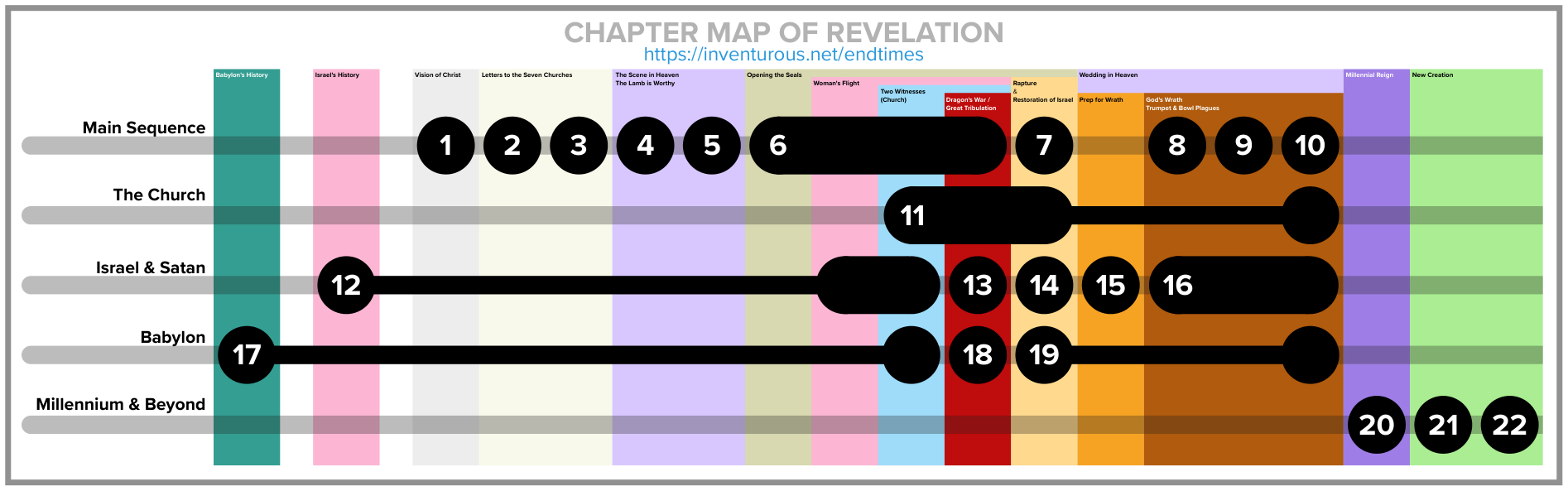
Revelation Chapter Map
The following guide is a broad outline for how I believe Revelation organizes its narratives and is the reading that this framework build upon (naturally, other frameworks interpret differently). If you think it may be useful in your own studies, you can click on the image to open it in a new window/tab for download or printing.